
Notifications
Posted by supriya maximize
Filed in Business 207 view
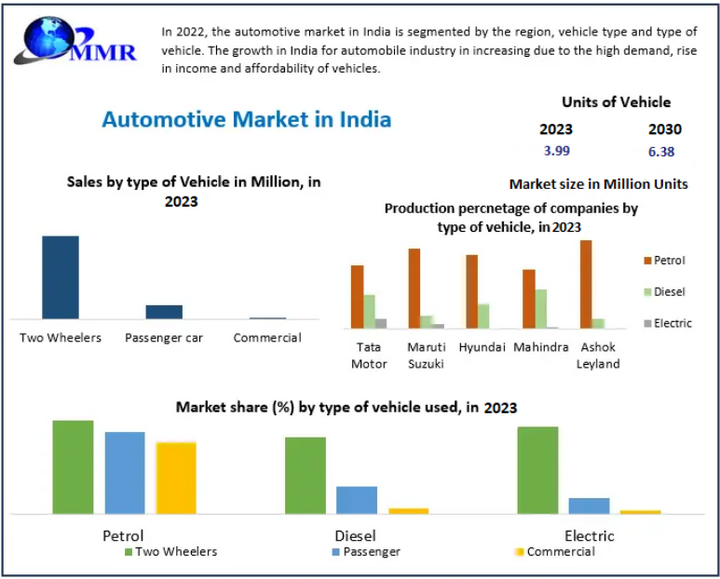
The Automotive Market in India reached 3.99 million units in 2023 and is projected to hit 6.38 million units by 2030, expanding at a CAGR of 6.94%. As one of the world’s fastest-growing mobility ecosystems, India’s automotive sector continues to evolve through electrification, policy reforms, export expansion, and rising consumer aspirations.
The automotive industry in India encompasses the manufacturing, distribution, and sales of vehicles spanning two-wheelers, passenger cars, commercial vehicles, and three-wheelers. India’s dominance is driven by:
A growing young population
Rising disposable incomes
Rapid urbanization
Supportive government policies
Demand for affordable and fuel-efficient vehicles
Automakers are steadily shifting toward EVs, connected vehicles, and advanced safety systems, which are reshaping the competitive landscape. Strong R&D participation—both domestic and global—continues to enhance innovation capabilities.
Find out where the real opportunities lie! Get your free report sample today by clicking here:https://www.maximizemarketresearch.com/request-sample/86126/
India’s expanding middle-class population and increasing workforce participation remain core growth accelerators. According to SIAM, over 1.69 million vehicles were produced in June 2021 alone, reflecting the sector’s strong production recovery post-pandemic.
Key Growth Drivers:
Rise in income levels and lifestyle upgrades
Demand for safer, more comfortable mobility solutions
Increasing exports (1.41 million units shipped between April–June 2021)
Booming digital retail and financing ecosystem
Government initiatives—such as FAME II, PLI scheme for the auto sector, and promotion of hybrid and electric vehicles—continue to support long-term transformation.
Despite its growth momentum, the industry faces substantial challenges:
High pollution levels in major cities pushing stricter emission norms
Rising production costs due to mandatory safety and emission upgrades
High manufacturing cost for EV batteries, sensors, ADAS & autonomous systems
Frequent regulatory revisions affecting production efficiency
Road infrastructure gaps, especially in rural regions
The cost of adopting cutting-edge technology continues to limit mass-scale implementation across all vehicle categories.
India is emerging as a global automotive R&D hub. Key developments include:
Government push through Make in India, Atmanirbhar Bharat and Automotive Mission Plan 2016–2026
Strong foreign investments for local production and component manufacturing
India accounting for 40% of global engineering and R&D spending (SIAM)
Rapid development in connected vehicles, telematics, autonomous features
Increased EV development boosting demand for wiring harnesses, sensors, batteries, and semiconductors
This innovation-led environment is strengthening India’s position in the global automotive value chain.
India’s worsening air quality—especially in cities like Delhi—has made EV adoption a necessity rather than a choice. Government measures include:
Lower GST on EVs
Strict BS6 emission standards
Incentives for EV buyers and manufacturers
Promotion of hybrid and electrified powertrains
With India becoming the world’s most populous country, traffic congestion and pollution concerns are expected to continue driving the electric mobility transition.
Two-wheelers account for the largest share due to:
Affordability
Fuel efficiency
Ease of mobility in congested cities
Suitability for both rural and urban terrain
Top players: Hero MotoCorp, Honda, Bajaj, TVS
Motorcycles lead demand, followed by scooters and mopeds.
Growth driven by:
Urbanization
Increasing working population
Financing availability
Rising preference for safety and comfort
Popular vehicle types: Hatchbacks, Sedans, SUVs, MPVs/MUVs
Growth supported by:
Expanding logistics & infrastructure
Increasing e-commerce penetration
Large-scale industrial and agricultural transport needs
Key players: Tata Motors, Ashok Leyland, Mahindra
Most affordable category
Widely available infrastructure
Higher popularity in small passenger cars and two-wheelers
Preferred for:
Heavy-duty applications
Long-distance travel
Trucks, buses, commercial fleets
Driven by:
Government incentives
Environmental concerns
Improving charging infrastructure
Fall in battery prices
Find out where the real opportunities lie! Get your free report sample today by clicking here:https://www.maximizemarketresearch.com/request-sample/86126/
High population density
Rapid urbanization
Strong demand for two-wheelers and SUVs
Expanding commercial vehicle adoption
Large agricultural footprint
Proximity to major ports (Mumbai, Kandla)
High demand for luxury cars
Rising infrastructure investments
Strong middle-class base
High 2-wheeler penetration
Strong IT ecosystem boosting automotive digitization
High demand for hatchbacks, SUVs, and rental fleets
Hilly terrain limiting mobility
Demand mainly in selective plain regions (Assam, Nagaland)
Growing two-wheeler usage for basic mobility
India’s automotive market is highly competitive with a mix of global and domestic giants.
Tata Motors Ltd – leader in passenger & electric cars; strong export presence
Maruti Suzuki India Ltd – mass-market leader; large-scale expansion in Haryana
Mahindra & Mahindra Ltd – strong SUV & EV brand
Hero MotoCorp, Honda, Bajaj, TVS – two-wheeler giants
Ashok Leyland, Eicher Motors – leaders in commercial vehicles
Hyundai Motor India, Toyota, Volkswagen – strong passenger car presence
Investments include:
Maruti Suzuki’s ₹18,000 crore manufacturing expansion
Hyundai’s ₹2,000 crore new HQ and facility upgrades
Mahindra’s USD 403 million investment in EV manufacturing
Surge in EV and hybrid vehicle adoption
Expansion of connected and autonomous features
Growth in shared & subscription-based mobility
Increase in automotive exports
Strengthening domestic component manufacturing
Market to reach 6.38 million units by 2030
EV segment to grow at >30% CAGR
Two-wheelers to remain dominant
SUVs to continue leading passenger car sales
The Automotive Market in India is undergoing a major transformation driven by innovation, policy reforms, electrification, and rising consumer expectations. With strong domestic demand and increasing global interest, India is positioned to become one of the most influential automotive markets in the world by 2030.