
Notifications
Posted by supriya maximize
Filed in Business 222 view
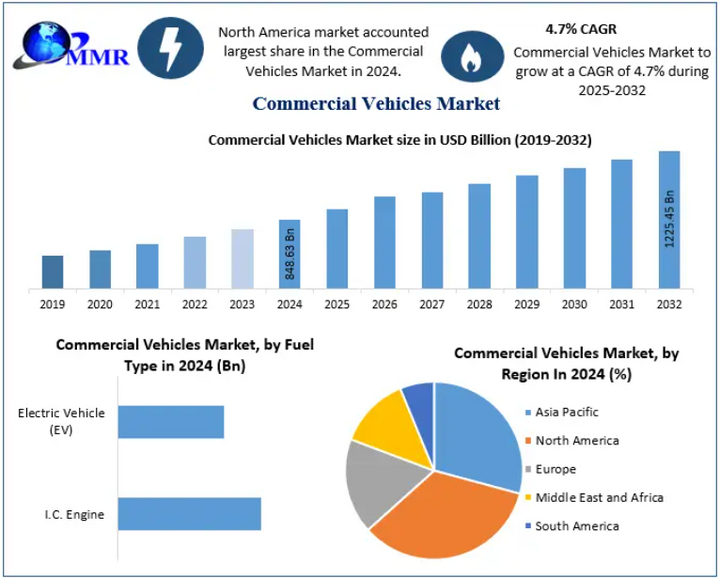
Commercial Vehicles Market: Global Industry Analysis, Trends, and Forecast (2025–2032)
The Commercial Vehicles Market, valued at USD 848.63 billion in 2024, is projected to reach USD 1225.45 billion by 2032, expanding at a CAGR of 4.7% during the forecast period. The market is witnessing strong momentum driven by fleet electrification, expanding logistics operations, rising construction activity, and rapid technological advancements enhancing vehicle efficiency and safety.
Market Overview
Commercial vehicles (CVs) include light commercial vehicles (LCVs), heavy-duty trucks, buses, and coaches, used across industries such as logistics, mining, construction, passenger transportation, and last-mile delivery.
The expanding global trade ecosystem, increasing freight movement, and strengthening road infrastructure—particularly across emerging economies—are contributing to substantial market growth. Governments globally are enforcing stricter vehicle emission norms, leading to significant investments in electric and hybrid commercial fleets.
To know the most attractive segments, click here for a free sample of the report:https://www.maximizemarketresearch.com/request-sample/112685/
Market Dynamics
Electrification is transforming commercial mobility as companies increasingly replace diesel fleets with electric commercial vehicles (ECVs). Key factors driving this shift include:
India, for instance, contributes significantly to global emissions through freight movement—freight vehicles account for 38% of India’s transport CO₂ emissions. This creates substantial opportunities for the adoption of eLCVs, e-buses, and electric heavy trucks.
Fleet charging infrastructure, though currently less than 10% of total charging capacity, is expected to grow exponentially with rising fleet electrification trends, especially across e-commerce and MaaS platforms.
Digital and automated technologies are reshaping the commercial vehicle ecosystem:
Additionally, emerging A.C.E. technologies (Autonomous, Connected, Electric) are transforming value chains with new regulations, safety standards, and data-driven vehicle design.
Large-scale global investments in:
These projects require continuous movement of raw materials and heavy equipment, increasing demand for both heavy-duty trucks and LCVs. Rapid urbanization is also boosting the need for commercial transit buses.
The explosion of e-commerce has significantly increased last-mile delivery needs, pushing demand for:
Companies are expanding warehouse networks and adopting time-critical delivery models, leading to accelerated commercial vehicle procurement globally.
Despite strong growth, the market faces challenges:
These factors can restrain adoption, particularly in price-sensitive markets.
Commercial Vehicles Market Segment Analysis
By Type
The LCV segment dominated the market due to:
In India, the 3.5T–7T truck category is a major contributor to small and medium fleet operations.
Widely used in:
Major players in heavy-duty trucks include Daimler, Volvo, Tata Motors, Scania, Paccar, Navistar, and Dongfeng.
Expected CAGR: 3.1% (2025–2032)
Growth driven by:
By End Use
Growth factors:
Expected strong growth due to:
Fueled by global infrastructure megaprojects.
To know the most attractive segments, click here for a free sample of the report:https://www.maximizemarketresearch.com/request-sample/112685/
Regional Analysis
Growth driven by:
The Inflation Reduction Act could enable deployment of 1.1 million class 4–8 electric trucks by 2030.
Key drivers:
China and India remain the powerhouses of commercial vehicle sales.
Growth supported by:
Competitive Landscape: Key Players
North America
Europe
Asia Pacific
Conclusion
The Commercial Vehicles Market is undergoing a major transformation driven by:
While operational costs remain a challenge, rising sustainability priorities, regulatory push, and disruptive technologies are setting the stage for a more efficient, connected, and environmentally sustainable commercial vehicle landscape by 2032.