
الإشعارات
نشرت من supriya maximize
مصنفة في الأعمال والمشاريع 140 مشاهد
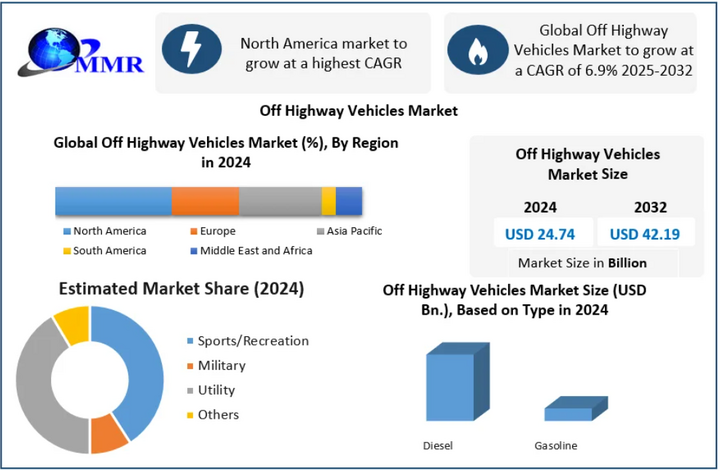
Global Off-Highway Vehicles Market Poised to Reach USD 42.19 Billion by 2032 as Electrification and Automation Redefine Demand
The Global Off-Highway Vehicles (OHV) Market continues its upward trajectory, with the industry valued at USD 24.74 billion in 2024 and projected to expand at a CAGR of 6.9% through 2032, ultimately reaching USD 42.19 billion. This strong outlook reflects rising infrastructure investments, the modernization of construction and agricultural operations, and fast-advancing electrification and automation technologies.
Defining the Off-Highway Vehicle Market
Off-highway vehicles comprise a broad range of machinery designed for rugged, off-road operations including construction equipment, mining machines, and agricultural vehicles such as excavators, bulldozers, loaders, tractors, harvesters, and utility vehicles. Built for durability and high load-bearing capacity, OHVs form the backbone of global industrial expansion—powering urban development, resource extraction, and modern farming.
As smart technologies integrate deeper into heavy-duty machinery, OHVs are evolving rapidly into intelligent, connected systems capable of autonomous operation, predictive diagnostics, and reduced emissions.
To know the most attractive segments, click here for a free sample of the report:https://www.maximizemarketresearch.com/request-sample/74216/
Market Dynamics: What’s Fueling Growth
Governments and private developers across developed and emerging economies are investing heavily in smart cities, transportation networks, and energy infrastructure. The shift toward sustainable construction and urban housing modernization is intensifying the demand for powerful, reliable OHVs.
Leasing of heavy construction equipment is also growing as companies seek cost-efficient alternatives to ownership, expanding access to modern machinery.
The OHV industry is undergoing a fundamental transformation with the introduction of:
These innovations support cleaner, more efficient operations—especially crucial in regulated or urban zones. Governments are encouraging the shift with incentives and stricter emission norms that support next-generation equipment.
Industries like oil & gas, tunneling, hydropower, and power generation increasingly rely on special-purpose OHVs optimized for extreme conditions and high-precision excavation.
Emerging markets are focusing on industrial expansion, mining exploration, smart logistics, and modern agricultural practices—further amplifying OHV demand. With better torque, higher traction, and improved weight distribution, all-wheel-drive OHVs are gaining traction in both commercial and recreational segments.
Challenges: What Could Slow Down the Market
Despite its momentum, the global OHV market faces several structural challenges:
Developing electric powertrains, autonomous systems, and advanced battery solutions requires significant investment, often limiting adoption among smaller OEMs.
Semiconductor shortages, disruptions in battery raw materials, and logistics inefficiencies continue to affect production schedules.
Construction sites, mining areas, and rural farms lack the fast-charging networks necessary for seamless electric OHV deployment.
Regional variations in emissions, safety standards, and agricultural norms complicate the ability of OEMs to scale globally.
Market Segmentation Analysis
By Fuel Type
By Application
By Construction Machinery Power Range
By Agricultural Machinery Power Range
To know the most attractive segments, click here for a free sample of the report:https://www.maximizemarketresearch.com/request-sample/74216/
Regional Insights: North America Leads the Global Market
North America dominated the OHV industry in 2024, supported by:
North America will remain a major global hub owing to its OEM ecosystem, strong dealer networks, and leadership in technological innovation.
Competitive Landscape: Innovation at the Forefront
The OHV market is defined by the presence of global heavyweights and rapidly growing regional manufacturers. Key players include:
Top Global OEMs
These companies are investing heavily in:
Recent Strategic Developments (2025)
Conclusion: A Market Entering a New Era of Innovation
The Global Off-Highway Vehicles Market is undergoing its most transformative period in decades. Infrastructure expansion, rapid urbanization, mining recovery, and precision agriculture continue to propel market growth worldwide. Meanwhile, electrification, AI integration, sustainability, and connected machinery are reshaping the competitive landscape and setting new performance benchmarks.
As global OEMs accelerate investments in smart, efficient, and low-emission machinery, and governments continue to support infrastructure modernization, the OHV industry is positioned for robust, long-term growth. With demand intensifying across construction, agriculture, recreational activities, and mining, the market will continue evolving into a high-tech ecosystem built on automation, sustainability, and data-driven intelligence.