
Notifications
Posted by supriya maximize
Filed in Technology 121 view
Edge AI Software Market: Global Trends, Growth Drivers, and Future Outlook (2024–2030)
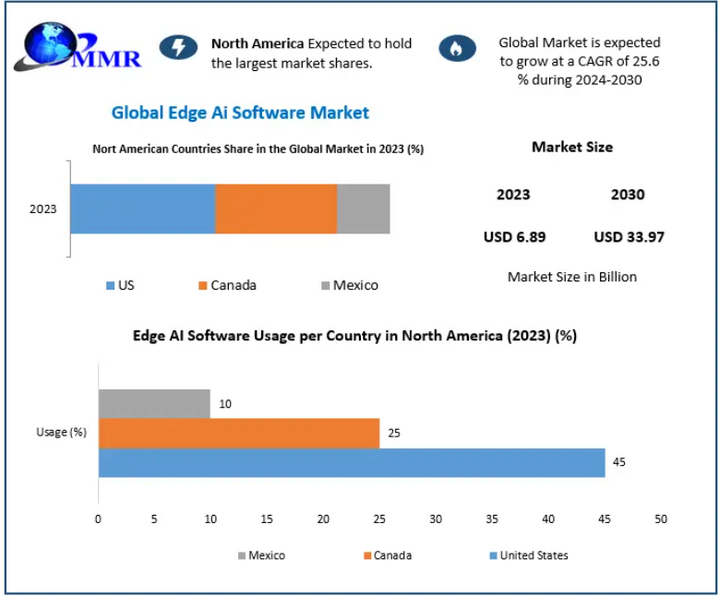
The Edge AI Software Market, valued at USD 6.89 billion in 2023, is projected to reach USD 33.97 billion by 2030, expanding at a robust CAGR of 25.6%. This rapid growth is driven by the rising need for real-time processing, reduced latency, increased data security, and the widespread adoption of IoT devices, 5G, and AI-enabled edge systems across industries.
Market Overview
Edge AI, often described as the next evolution of artificial intelligence, brings computation closer to the data source—at the “edge” of the network. Instead of relaying data to centralized cloud platforms, edge AI processes information on local devices such as cameras, sensors, mobile phones, industrial equipment, and autonomous systems.
This shift enables organizations to:
Industries such as manufacturing, automotive, healthcare, energy, and telecom are making rapid investments in edge AI solutions to automate processes, enhance safety, and boost operational efficiency.
Click Here to Receive a Free Sample of the Report:https://www.maximizemarketresearch.com/request-sample/28038/
Market Dynamics
Key Growth Drivers
Edge AI enables instant decision-making—critical for applications like:
Processing data locally drastically reduces delays that occur in cloud-based architectures.
Since the data remains on the device, risks associated with cloud transfer and storage are minimized. This decentralized approach improves security and compliance, particularly for industries dealing with sensitive data.
Local data processing reduces network loads, especially in environments with:
This significantly lowers operational costs.
Organizations can deploy AI models across distributed systems and effortlessly scale workloads. This flexibility is transforming industries reliant on real-time insights and automation.
Market Restraints
Despite promising growth, several challenges exist:
Edge devices cannot match the computational strength of cloud servers. This restricts the deployment of large-scale AI models.
Embedding edge AI into legacy systems requires significant upgrades and compatibility testing, often leading to high integration costs.
Edge devices are exposed to physical tampering or environmental risks, making cybersecurity more challenging.
AI model effectiveness heavily depends on the quality and diversity of training data, which may be limited in decentralized environments.
While edge AI reduces long-term costs, the upfront cost of specialized hardware and software can slow adoption.
Technological Innovations Powering Edge AI
The rise of edge AI is supported by innovations in:
Advanced deep learning models are now optimized for deployment on compact edge devices.
Cutting-edge processors such as:
These advancements enable real-time AI inference at the edge.
Mass adoption of IoT devices combined with ultra-fast 5G networks dramatically enhances data collection, processing, and edge deployment capabilities.
Market Segmentation
By Component
By Data Source
By Application
By Vertical
Click Here to Receive a Free Sample of the Report:https://www.maximizemarketresearch.com/request-sample/28038/
Regional Analysis
North America – Global Leader
The U.S. leads the market due to:
Europe – Rapid Digital Transformation
Countries like Germany, France, and the UK are accelerating edge AI adoption through:
Asia Pacific – Fastest Growing Market
APAC growth is driven by:
Middle East & Africa – Emerging Opportunity
Growth supported by:
Key Market Players
Global Leaders
North America
Asia Pacific
Europe
Middle East & Africa