
Notifications
Posted by supriya maximize
Filed in Technology 119 view
Blockchain Gaming Market: Global Industry Outlook, Strategies & Future Opportunities (2024–2030)
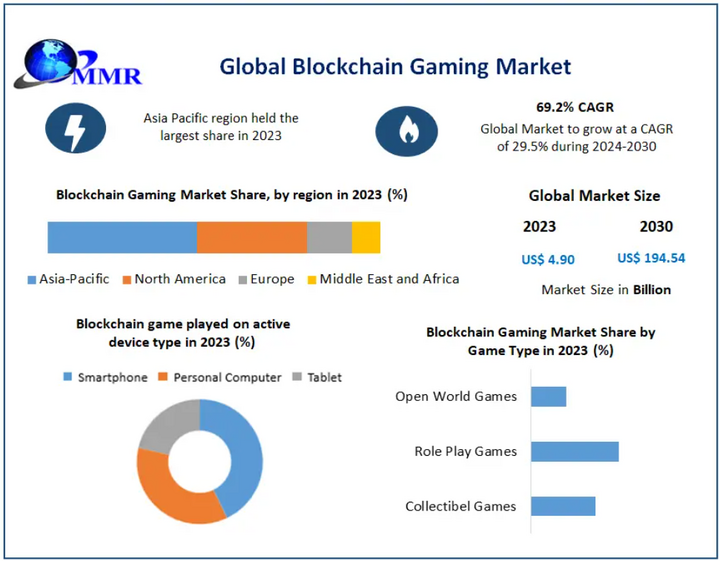
The Blockchain Gaming Market has been experiencing an extraordinary transformation, rising far beyond the traditional boundaries of the gaming ecosystem. Valued at USD 4.90 billion in 2023, the market is forecast to surge to USD 194.54 billion by 2030, expanding at an unprecedented CAGR of 69.2%. This explosive growth reflects a new era in the gaming landscape—one in which players gain verifiable ownership over virtual items, participate in decentralized in-game economies, and seamlessly monetize their gameplay experiences.
Market Overview
Blockchain gaming blends decentralized technology with interactive entertainment, reshaping how digital assets, gameplay interactions, and in-game economies function. Unlike conventional titles where game developers retain full control over digital assets, blockchain-powered games allow players to own, trade, and transfer their items using NFTs, cryptocurrencies, and smart contracts.
This transition from closed ecosystems to open, decentralized environments is fueling the demand for blockchain-based titles. Increasing smartphone penetration, broader experience with crypto, and rising interest in play-to-earn (P2E) models are further accelerating adoption.
To know the most attractive segments, click here for a free sample of the report:https://www.maximizemarketresearch.com/request-sample/221874/
Recent Market Highlights
Market Dynamics
✔ True Ownership Through NFTs
Blockchain ensures that in-game items exist as unique, player-controlled digital assets. Players no longer rely on centralized servers, which historically restricted reselling, transferring, or monetizing assets.
✔ Decentralized Trust & Security
Blockchain offers tamperproof, transparent ledgers that eliminate third-party dependencies. This minimizes fraud, duplication, and hacking risks—issues common in traditional gaming ecosystems.
✔ Rise of Play-to-Earn (P2E) Economies
P2E models allow gamers to earn tokens by completing missions, farming resources, or trading assets. This has turned gaming from a leisure activity into a potential income stream, especially in developing markets.
✔ Technological Advancements in Smartphones
With billions of smartphone users worldwide, mobile-based blockchain games are seeing rapid adoption. Enhanced processors, better graphics, and integrated crypto-wallet features support this shift.
✔ Growth of Cross-chain Interoperability
Players increasingly seek flexibility and access, prompting developers to enable asset transfer across multiple blockchains. This interoperability is fueling innovation and expanding game utility.
✘ High Initial Barriers
Setting up crypto wallets, understanding tokens, gas fees, and blockchain mechanics can overwhelm casual users, slowing mass adoption.
✘ Scalability & Transaction Delays
Many blockchain networks still struggle with high congestion, leading to higher gas fees and slower gameplay interactions.
✘ Environmental Concerns
Legacy blockchains contribute to increased electronic waste, especially due to mining equipment turnover.
✘ Uncertain Regulatory Landscape
Compliance complexities—such as AML and KYC requirements—create operational and legal challenges for gaming companies across jurisdictions.
Market Opportunities
✔ Expansion of NFT-based Gaming Economies
NFTs continue to revolutionize digital ownership. Gaming companies are integrating collectibles, avatars, skins, and virtual land with real-world value potential.
✔ Increasing Smartphone Adoption in APAC
Asia Pacific, home to the world’s largest gaming population, offers massive expansion opportunities for mobile-first blockchain titles.
✔ Investment Surge From Venture Capitalists
Since 2019, blockchain gaming has attracted USD 14.6 billion in investments, with 55% coming from Asia, indicating long-term confidence in the sector’s potential.
Segment Analysis
By Platform
Ethereum remains the top choice due to its decentralized security, smart contract reliability, and extensive game development community.
To know the most attractive segments, click here for a free sample of the report:https://www.maximizemarketresearch.com/request-sample/221874/
Regional Insights
Asia-Pacific – Market Leader (35% Share)
Asia Pacific dominates the global blockchain gaming market, driven by:
Countries like China, Japan, South Korea, the Philippines, and Vietnam are key hubs for blockchain gaming adoption.
Notable Trends in APAC
Competitive Landscape
Key players are focusing on innovation, NFT-based economies, cross-chain capabilities, and user-friendly wallets. Strategic collaborations, funding rounds, and platform upgrades are shaping the competitive environment.
Leading Companies
These companies are pioneering decentralized virtual worlds, NFT marketplaces, and blockchain-based game assets.
Conclusion
The blockchain gaming market is entering a transformative era where player empowerment, digital ownership, decentralized economies, and cross-platform interoperability redefine the future of entertainment. Although regulatory uncertainties and scalability issues pose challenges, the market’s exponential growth projections emphasize its immense potential.
As technological advancements continue to unlock new possibilities—and as global gaming communities embrace Web3 experiences—the industry is poised for explosive evolution through 2030.