
Notifications
Posted by supriya maximize
Filed in Technology 109 view
Global Private 5G Network Market: Growth, Trends, and Strategic Outlook (2024–2030)
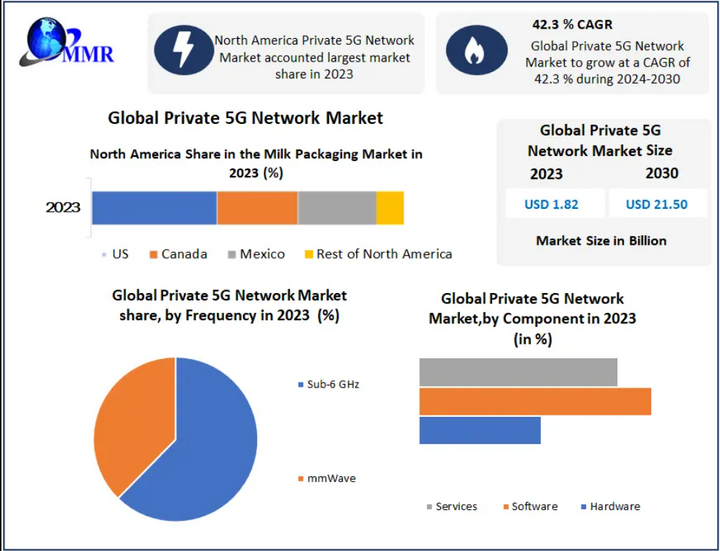
The Global Private 5G Network Market was valued at USD 1.82 billion in 2023 and is projected to surge to USD 21.50 billion by 2030, expanding at an impressive CAGR of 42.3% during the forecast period. This remarkable growth reflects the accelerating adoption of private 5G infrastructure across industrial, enterprise, and mission-critical environments worldwide.
Market Overview
Private 5G networks are dedicated cellular networks designed to serve specific organizations or facilities, offering superior performance, ultra-low latency, enhanced security, and high reliability compared to public networks. Unlike public 5G, private networks allow enterprises to maintain full control over network access, spectrum usage, and data governance.
Industries such as manufacturing, transportation, healthcare, energy, logistics, and defense are increasingly deploying private 5G to support Industry 4.0, autonomous operations, real-time analytics, and mission-critical communications. These networks act as the backbone for smart factories, autonomous vehicles, remote monitoring systems, and advanced digital ecosystems.
Enterprises can acquire spectrum through mobile network operators (MNOs), government auctions, or shared/unlicensed spectrum models, depending on regional regulations. As a result, private 5G is rapidly emerging as a core enabler of enterprise digital transformation.
To know about the Research Methodology :-Request Free Sample Report@https://www.maximizemarketresearch.com/request-sample/188048/
Market Growth Drivers
Rising Demand for High-Performance Connectivity
The need for ultra-fast data transmission and low-latency communication is a primary driver of private 5G adoption. Applications such as robotics, automation, predictive maintenance, and real-time video analytics require network performance that traditional Wi-Fi or LTE solutions often cannot deliver.
Increased Focus on Security and Reliability
With the rise in cyber threats and data breaches, organizations are prioritizing secure communication frameworks. Private 5G networks provide dedicated, isolated environments with customizable security policies, making them ideal for sensitive industrial and enterprise use cases.
Expansion of Industry 4.0 and IIoT
The growing use of Industrial Internet of Things (IIoT), artificial intelligence, and automation is fueling demand for private 5G. These networks support massive device connectivity, deterministic performance, and real-time data processing essential for modern industrial operations.
Government and Enterprise Investments
Governments and private players are investing heavily in 5G infrastructure and spectrum allocation. Major technology vendors such as Ericsson, Nokia, Huawei, and Qualcomm are continuously advancing private 5G solutions, further accelerating market growth. Countries including India are actively strengthening their private 5G ecosystem to support industrial modernization.
Market Restraints
High Deployment and Maintenance Costs
Deploying a private 5G network requires substantial capital investment in hardware, spectrum licensing, software, and ongoing maintenance. Depending on network scale and complexity, costs can range from USD 500,000 to over USD 5 million, posing a challenge for small and mid-sized enterprises.
Skilled Workforce Shortage
The design, deployment, and management of private 5G networks demand specialized technical expertise. A global shortage of skilled telecom and network professionals may slow adoption, particularly in emerging markets.
Spectrum and Regulatory Challenges
Access to licensed spectrum varies significantly across regions and is often tightly regulated. Differences in national policies, spectrum availability, and interoperability standards can create barriers to market expansion.
Competition from Wi-Fi and LTE
Established technologies such as Wi-Fi 6 and private LTE continue to compete with private 5G, especially in cost-sensitive applications where ultra-low latency is not critical.
Emerging Market Trends
Integration of Edge Computing and Network Slicing
The convergence of edge computing and network slicing is reshaping private 5G deployments. These technologies allow enterprises to create virtualized network segments tailored to specific applications, enabling advanced use cases such as autonomous vehicles, smart cities, and remote healthcare.
Growth of Open RAN Architecture
The adoption of Open Radio Access Network (Open RAN) is gaining momentum, offering improved flexibility, vendor interoperability, and cost efficiency. Open RAN is expected to accelerate private 5G adoption, particularly in customized industrial deployments.
Expansion in Mission-Critical Applications
Private 5G is increasingly used in public safety, defense, emergency response, and utilities, where reliability, resilience, and security are paramount.
Rising Demand for Indoor Connectivity
Airports, stadiums, factories, shopping malls, and smart offices are deploying private 5G to support high-density indoor connectivity, immersive technologies such as AR/VR, and advanced enterprise applications.
Market Segmentation Analysis
By Component
By Frequency
By Spectrum
By Vertical
To know about the Research Methodology :-Request Free Sample Report@https://www.maximizemarketresearch.com/request-sample/188048/
Regional Insights
North America
North America holds the largest market share, supported by early technology adoption, strong industrial demand, and favorable spectrum policies. The region is expected to grow at a CAGR of 29.3% through 2030.
Europe
Europe is witnessing rapid adoption driven by Industry 4.0 initiatives and digital transformation across manufacturing and utilities. The market is projected to grow at a CAGR of 31.4%.
Asia-Pacific
Asia-Pacific is expected to register the highest growth rate, with a forecast CAGR of 35.3%, fueled by expanding industrialization, smart infrastructure projects, and increasing investments in countries such as China, Japan, South Korea, and India.
Rest of the World
South America, the Middle East, and Africa are gradually adopting private 5G, driven by demand for connectivity in remote locations and critical infrastructure.
Competitive Landscape
The Private 5G Network Market is highly competitive and innovation-driven. Leading players include:
Telecom operators such as Verizon, AT&T, Deutsche Telekom, Orange, and Telefónica are actively partnering with technology providers to deliver enterprise-grade private 5G solutions. Continuous R&D investments, strategic collaborations, and product innovation remain key competitive strategies.
Conclusion
The global private 5G network market is entering a transformative growth phase, driven by digitalization, industrial automation, and the demand for secure, high-performance connectivity. Despite challenges related to cost, spectrum, and skills availability, technological advancements and increasing enterprise adoption are expected to sustain strong market momentum through 2030. Private 5G will play a pivotal role in shaping the future of connected industries and mission-critical communication worldwide.