Higher Education Market Consumer Behavior and Student Preference Insights 2030

نشرت من supriya maximize ٧ يناير

مصنفة في التكنولوجيا 62 مشاهد

Global Higher Education Market: Transforming Learning for the Future

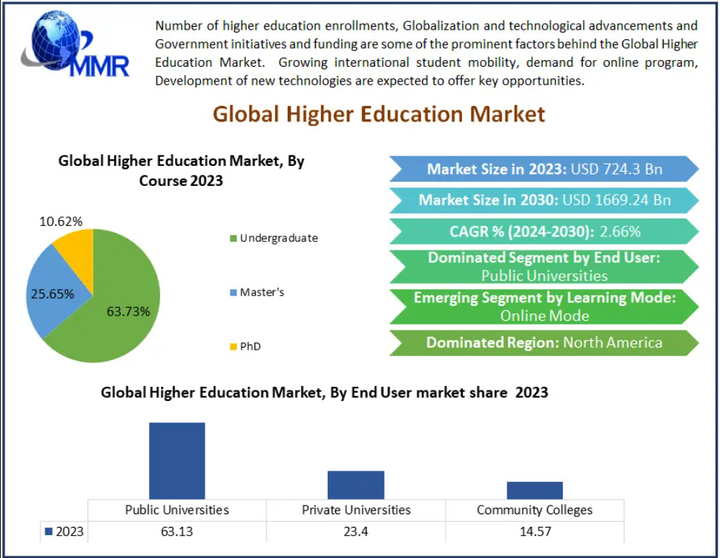
The Global Higher Education Market is rapidly evolving, shaping the knowledge economy and empowering individuals worldwide. Valued at USD 724.3 Billion in 2023, the market is expected to grow at a CAGR of 12.66% from 2024 to 2030, reaching nearly USD 1,669.44 Billion by 2030. This growth reflects the rising global demand for advanced education, technological integration, and international mobility of students.

Market Overview

Higher education refers to post-secondary education and research, offered through universities, colleges, academies, vocational schools, and other degree-granting institutions. The sector plays a pivotal role in fostering economic, social, and environmental development, equipping students with critical thinking, problem-solving, and professional skills.

The market is being reshaped by technological advancements, including AI, online learning platforms, virtual reality, and adaptive learning tools, which are transforming traditional classroom education into a flexible, global, and accessible learning ecosystem.

To know the most attractive segments, click here for a free sample of the report:https://www.maximizemarketresearch.com/request-sample/7167/ 

Key Market Drivers

  1. Rising Enrollment and Global Student Mobility
    As global populations grow and the value of higher education increases, more students are pursuing degrees, especially in developing countries like India and China. International student mobility is also creating a competitive and diverse higher education landscape.
  2. Technological Advancements
    EdTech innovations are revolutionizing higher education. Platforms like Coursera, EdX, and FutureLearn allow students worldwide to access quality programs and degrees remotely. Interactive technologies such as VR simulations and gamification enhance learning, engagement, and skill development.
  3. Government Initiatives and Funding
    Governments across the world are investing heavily in higher education. Programs like SWAYAM in India, federal aid in the US, and tuition support in the UK are improving access, affordability, and quality. These initiatives help institutions expand their offerings and attract more students.
  4. Growing Demand for Skilled Workforce
    Employers increasingly value higher education for critical skills, job readiness, and innovation. The demand for professionals in research, engineering, technology, business, and healthcare is driving students toward higher education globally.

Market Segmentation

By Course: Undergraduate, Master’s, PhD

  • Undergraduate programs dominate due to broader accessibility and affordability.
  • Postgraduate programs are growing rapidly in specialized fields like business, computer science, and engineering.

By End User: Public Universities, Private Universities, Community Colleges

  • Public universities hold the largest market share due to government funding, lower tuition, and diverse academic programs.
  • Private universities are expanding, especially in developing countries, offering specialized courses and flexible curricula.

By Learning Mode: Online, Offline

  • Offline learning remains dominant due to in-person labs, social interaction, and structured environments.
  • Online learning is growing at a CAGR of over 13%, driven by flexible scheduling, affordability, and technological adoption.

Regional Insights

  • North America leads the market, driven by renowned universities like Harvard, MIT, and Stanford, high investment in EdTech, and international student attraction.
  • Asia Pacific is emerging as the fastest-growing region, fueled by large student populations in China and India, government investments, and increasing recognition of higher education for career advancement.
  • Europe continues to maintain quality standards and attract international students through established institutions.
  • Middle East, Africa, and South America are experiencing growth due to expanding access, digital learning initiatives, and government support.

To know the most attractive segments, click here for a free sample of the report:https://www.maximizemarketresearch.com/request-sample/7167/ 

India Higher Education Market

India’s higher education sector is expanding rapidly, with over 50,734 colleges and 1,265 universities as of 2024. Initiatives like free higher education for girls in Maharashtra and programs promoting online learning are creating more opportunities for domestic and international students. India is attracting students from Nepal, Afghanistan, the US, Bangladesh, and the UAE, making it a key regional hub for higher education.

Industry Recommendations

  1. Invest in Online Learning Platforms – Flexible, high-quality online programs will expand reach and affordability.
  2. Leverage Educational Technology – Tools like VR, AI, and adaptive learning improve engagement and learning outcomes.
  3. Partner with Industries – Collaborations ensure programs align with workforce needs and employability.
  4. Provide Comprehensive Student Support – Academic advising, career counseling, and mental health services enhance student success and retention.

Key Global Players

Top institutions and EdTech providers shaping the market include: Harvard University, MIT, Stanford University, Peking University, University of Oxford, Columbia University, California Institute of Technology, Tsinghua University, Apollo Education Group, Adtalem Global Education, among others. These players are driving innovation, expanding access, and redefining the global higher education landscape.

Conclusion:

The Global Higher Education Market is undergoing a major transformation, fueled by technological innovation, rising enrollment, and internationalization. The market presents vast opportunities for institutions, EdTech providers, and governments to create a more accessible, flexible, and globally competitive education ecosystem, preparing students to become the innovators, leaders, and problem-solvers of tomorrow.

click to rate