
Notifications
Posted by supriya maximize
Filed in Business 59 view
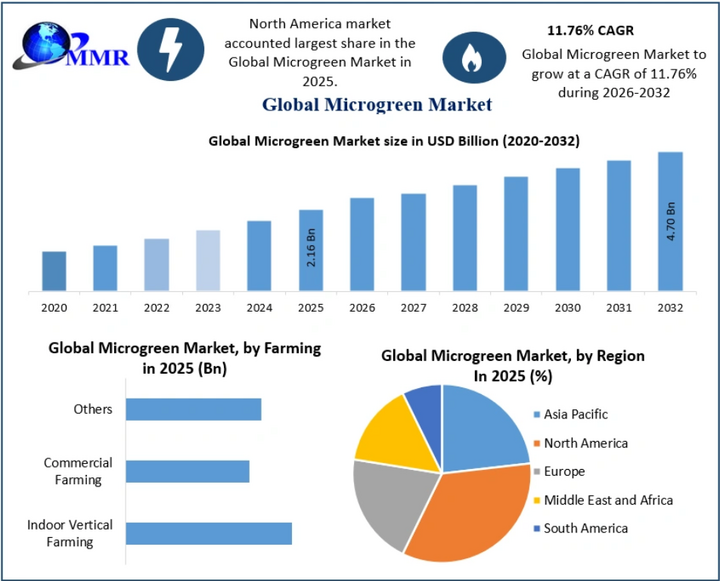
Microgreen Market Outlook (2025–2032)
The global Microgreen Market was valued at USD 2.16 billion in 2025 and is projected to reach approximately USD 4.70 billion by 2032, growing at a CAGR of 11.76% during the forecast period. This strong growth trajectory is driven by rising consumer awareness of nutrition, expanding adoption of indoor and vertical farming practices, and increasing demand from foodservice and retail sectors.
Microgreens have emerged as a premium category of specialty crops, gaining popularity across urban households, fine-dining restaurants, and health-conscious consumer segments worldwide.
Market Overview
Microgreens are young, tender edible plants harvested at an early stage of growth, typically measuring 2.5–7.6 cm in height. They develop after the cotyledon leaves emerge and are distinct from sprouts, as they are grown under light and harvested above the soil surface. Due to their vibrant colors, delicate textures, and concentrated flavors, microgreens are widely used as garnishes, flavor enhancers, and nutritional boosters.
Often referred to as “vegetable confetti,” microgreens are cultivated from seeds of vegetables, herbs, and grains. Common varieties include broccoli, basil, arugula, radish, peas, and cabbage. Although traditionally associated with gourmet cuisine, microgreens are increasingly finding their way into home kitchens and retail food baskets.
To know the most attractive segments, click here for a free sample of the report:https://www.maximizemarketresearch.com/request-sample/221008/
Market Drivers
Rising Popularity in Culinary Applications
The growing use of microgreens in global cuisines is a key growth driver. Chefs and food innovators favor microgreens for their ability to enhance taste, aroma, texture, and visual appeal. Popular dishes such as microgreen salads, avocado toast, smoothies, pizzas, soups, and wraps increasingly feature these greens.
Beyond aesthetics, microgreens offer substantial nutritional benefits. They are rich in ascorbic acid, phylloquinone (vitamin K), carotenoids, and polyphenols, which are associated with reduced risks of cardiovascular disease, cognitive decline, and inflammation. This dual appeal—culinary and nutritional—has significantly expanded their adoption across foodservice channels.
Health Awareness and Preventive Nutrition
Growing awareness of lifestyle-related diseases and age-related disorders has led consumers to prioritize functional and nutrient-dense foods. Microgreens are increasingly viewed as preventive nutrition sources due to their antioxidant and anti-inflammatory properties. The trend is particularly strong in emerging economies, where aging populations and urbanization are reshaping dietary preferences.
Market Restraints
High Prices and Short Shelf Life
Despite growing demand, microgreens remain a premium product. Their higher cost compared to conventional vegetables is a major barrier to mass adoption. Production requires controlled environments, quality seeds, skilled labor, and post-harvest handling, all of which increase costs.
Additionally, microgreens have a short shelf life, making storage and transportation challenging. They are highly sensitive to temperature, humidity, and handling, which can lead to spoilage and food safety risks. Issues related to microbial contamination, including Salmonella and Listeria outbreaks, have prompted increased scrutiny and recalls in some markets.
Emerging Trends
Expansion of Indoor and Vertical Farming
The microgreen market is closely linked to the growth of indoor vertical farming and controlled environment agriculture (CEA). These systems allow year-round production, reduced water usage, minimal pesticide application, and higher yield per square foot. Technological advancements in LED lighting, hydroponics, and climate control are making microgreen farming more efficient and scalable.
Product Innovation and Variety Expansion
Producers are increasingly experimenting with new varieties, flavor profiles, and color combinations to differentiate products. Traits such as intense aroma, crunchy texture, vivid pigmentation, and unique taste are driving innovation. Collaboration with chefs and food brands is further accelerating product diversification.
Price Volatility and Market Challenges
The lack of standardized definitions and labeling regulations for microgreens creates confusion among consumers. Price fluctuations caused by input costs, climate sensitivity, and production scale also impact market stability. Additionally, growers must carefully manage root health, as fungal growth can be mistaken for mold, leading to quality concerns and potential losses.
Segment Analysis
By Type
Broccoli microgreens dominate the market due to their ease of cultivation, fast harvest cycle, and high nutritional value. Harvested within 10–14 days, broccoli microgreens are rich in calcium, minerals, and bioactive compounds that support cardiovascular health, brain function, and anti-aging benefits.
Other popular varieties include:
Color variations in microgreens also indicate specific phytochemicals, such as red pigments for antioxidants and purple hues for anthocyanins.
By End Use
The foodservice segment accounts for a significant share due to extensive use in restaurants, hotels, and catering services. Chefs rely on microgreens for plating aesthetics and flavor enhancement.
The retail segment is growing rapidly as consumers incorporate microgreens into home-cooked meals, smoothies, and salads. Increased availability through grocery stores, farmers’ markets, and online platforms is supporting this growth.
To know the most attractive segments, click here for a free sample of the report:https://www.maximizemarketresearch.com/request-sample/221008/
Regional Analysis
North America
North America represents the largest microgreen market, driven by health awareness, urban lifestyles, and strong demand from restaurants. The United States leads production, with California accounting for a major share of broccoli microgreens. Canada is a key producer of cabbage microgreens. Expanding retail distribution and growing interest in fresh, nutrient-rich foods continue to fuel regional growth.
Europe
Europe holds the second-largest market share, supported by advanced indoor farming infrastructure and strong consumer focus on organic and sustainable food. Germany and France dominate broccoli production, while Italy, Spain, the UK, and the Netherlands lead in other varieties. Strict food safety regulations and government initiatives promoting organic agriculture further strengthen the market.
Asia Pacific
Asia Pacific is an emerging high-growth region, led by China, Japan, South Korea, and India. Rising urbanization, increasing disposable incomes, and growing adoption of modern farming techniques are expanding market opportunities across the region.
Competitive Landscape
The global microgreen market is highly competitive, with over 200 participants operating at global, regional, and local levels. While a few large players dominate distribution networks, niche and country-specific producers hold significant market shares.
In October 2021, AeroFarms expanded its distribution across the Northeastern United States through partnerships with more than 350 Stop & Shop stores. The company leverages advanced vertical farming technology and culinary expertise to deliver premium microgreens with consistent flavor and nutrition.
Key Market Players
Conclusion
The global microgreen market is poised for sustained growth through 2032, supported by health-driven consumption, culinary innovation, and advances in indoor farming technology. While challenges such as pricing and shelf life persist, ongoing product innovation, expanding retail access, and rising nutritional awareness are expected to unlock new growth opportunities worldwide.