
Notifications
Posted by supriya maximize
Filed in Business 322 view
E-Rickshaw Market: Revolutionizing Urban Mobility through Sustainable Transportation
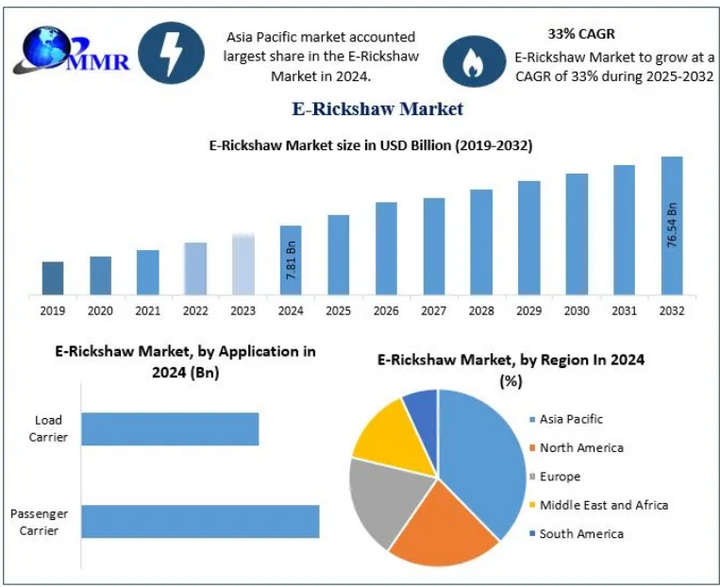
The Global E-Rickshaw Market was valued at USD 7.81 billion in 2024 and is projected to grow at a remarkable CAGR of 33% from 2025 to 2032, reaching nearly USD 76.54 billion by 2032. This exponential growth highlights the rising global shift toward eco-friendly, affordable, and efficient urban transportation solutions.
► Download a Free Sample Report Today:https://www.maximizemarketresearch.com/request-sample/72844/
E-rickshaws, commonly known as electric rickshaws, are three-wheeled vehicles powered by electric traction motors and batteries. They serve as a cost-effective and sustainable mode of passenger and goods transport, particularly in congested urban environments. With the growing emphasis on clean mobility and affordable commuting, e-rickshaws have emerged as a key driver in transforming the global electric mobility landscape.
Affordable Transportation Solution:
The low operational and maintenance cost of e-rickshaws compared to fuel-powered vehicles makes them an ideal choice for short-distance travel in densely populated cities.
Rapid Urbanization:
Increasing migration to urban areas and rising traffic congestion have fueled the demand for compact, flexible, and emission-free mobility options such as e-rickshaws.
Government Incentives and Emission Norms:
Stringent emission regulations and government subsidies on electric vehicles across Asia-Pacific nations like India and China are accelerating e-rickshaw adoption.
Technological Advancements:
Improvements in battery efficiency, motor power (1000–1500W range), and charging infrastructure are extending vehicle range and performance, increasing consumer confidence.
While growth prospects are robust, the market faces challenges such as the lack of widespread charging infrastructure, battery replacement costs, and inconsistent quality standards in unorganized manufacturing sectors. These factors may hinder large-scale adoption, especially in developing economies.
By Product Type:
Up to 1000W
1000W – 1500W (most in-demand segment)
Above 1500W
By Application:
Passenger Carrier (dominant segment driven by last-mile connectivity needs)
Load Carrier (growing due to demand in intra-city logistics and goods transport)
► Download a Free Sample Report Today:https://www.maximizemarketresearch.com/request-sample/72844/
The Asia Pacific region leads the global e-rickshaw market, with India, China, and Japan being major contributors. India, in particular, accounts for a substantial share owing to the government’s focus on electric mobility missions, FAME II incentives, and the rising number of e-rickshaw manufacturers and assemblers.
North America and Europe are emerging markets, primarily driven by environmental awareness, green mobility goals, and pilot adoption programs in urban centers.
The market is moderately fragmented, with both established automotive players and emerging manufacturers investing in product innovation, battery optimization, and design efficiency.
Key players include:
Mahindra Electric Mobility Limited
Bajaj Auto Limited
Saera Electric Auto Pvt. Ltd
Goenka Electric Motor Vehicles Pvt. Ltd
HHW Care Products India Pvt. Ltd
Green Valley Motors
SuperEco Automotive Co. LLP
Microtek
Wuxi Weiyun Motor Co. Ltd
Xuzhou Hongsengmeng Group Co., Ltd
These players are focusing on strategic partnerships, R&D in lithium-ion battery systems, and expansion into emerging markets to strengthen their global footprint.
The global e-rickshaw market is expected to witness massive growth over the next decade, driven by supportive policies, expanding urban populations, and increasing awareness about sustainable transportation. Integration with smart city initiatives, adoption of swappable battery technologies, and connected mobility features are poised to redefine the e-rickshaw ecosystem.
The E-Rickshaw Market stands at the forefront of the electric mobility revolution, bridging the gap between affordability and sustainability. As cities continue to prioritize low-emission transportation and governments push for electric vehicle adoption, e-rickshaws are set to become an indispensable component of the future urban transport infrastructure.