
Notifications
Posted by supriya maximize
Filed in Other 218 view
Global Indoor Farming Market – Industry Analysis & Forecast (2025–2032)
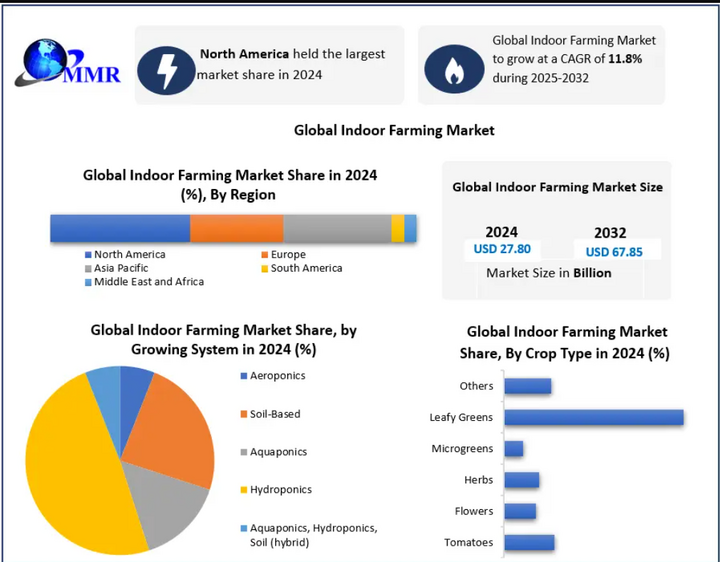
Market Size (2024): USD 27.80 Bn
Market Size (2032): USD 67.85 Bn
CAGR (2025–2032): 11.8%
Market Overview
The Indoor Farming Market is undergoing a transformative shift as the world moves toward sustainable, resource-efficient, and urban-focused food production models. Indoor farming, often referred to as Controlled Environment Agriculture (CEA), encompasses vertical farming, greenhouse cultivation, and container-based systems that leverage artificial lighting, climate automation, and hydroponic or aeroponic methods.
By enabling crops to grow year-round irrespective of natural climate conditions, indoor farming provides a consistent, high-quality, and pesticide-free food supply. As global populations concentrate in metropolitan areas and food security challenges increase, indoor farming has become a vital solution in modern agriculture.
In 2024, the global indoor farming market reached USD 27.80 Bn, and strong adoption across North America, Europe, and Asia-Pacific positions the market to grow to nearly USD 67.85 Bn by 2032.
To know the most attractive segments, click here for a free sample of the report: https://www.maximizemarketresearch.com/request-sample/110252/
Market Dynamics
Key Growth Drivers
1. Rising Demand for Fresh, Local, and Chemical-Free Produce
Consumers worldwide are shifting toward fresh, nutrient-rich, and pesticide-free food. Indoor farms located near urban centers cut transportation time, reduce spoilage, and provide fresher produce, fueling rapid adoption among households and retailers.
2. Advancements in Agricultural Technology
Breakthroughs in LED grow lighting, smart sensors, HVAC optimization, hydroponics/aeroponics, and automation systems have drastically improved productivity.
These technologies allow growers to control:
The result: higher yields, faster plant growth, and lower resource consumption.
3. Growing Awareness of Sustainability and Food Security
Indoor farming consumes up to 90% less water, eliminates agricultural runoff, and uses significantly less land than traditional farming. Governments, investors, and urban communities are increasingly supporting CEA to address climate change, food scarcity, and supply chain disruptions.
4. Expanding Investment & Venture Capital Funding
As the economic viability of indoor farming improves, venture capital firms, private investors, and government agencies are investing heavily in infrastructure, R&D, and startup growth—all contributing to market expansion.
Market Restraints
1. High Initial Capital Requirements
Indoor farms require expensive lighting systems, climate-controlled facilities, automated equipment, and skilled labor. This high capital expenditure restricts participation from small and mid-sized growers.
2. High Energy Consumption
Lighting, cooling, heating, and ventilation systems consume substantial electricity. While LED efficiency is improving, energy remains one of the largest operational costs, exposing businesses to fluctuating power prices.
3. Limited Consumer Awareness
Despite its benefits, indoor-grown produce is still perceived by some consumers as “less natural” than traditionally farmed crops. Market education and branding are required to increase acceptance.
4. Competition from Low-Cost Traditional Agriculture
Open-field farming remains cheaper for mass-produced crops such as grains and staples. Indoor farming must justify higher prices through premium quality, reduced pesticides, and local freshness.
Segment Analysis
By Growing System
✔ Hydroponics (Dominant Segment in 2024)
Hydroponics uses nutrient-rich water solutions instead of soil, giving growers precise control over crop nutrition. Benefits include:
Given these advantages, hydroponics will remain the leading segment during the forecast period.
Other Growing Systems:
By Facility Type
✔ Glass or Poly Greenhouse (Market Leader)
Greenhouses allow natural light to be combined with supplemental LED lighting, offering fully controlled environments ideal for large-scale commercial farming.
Advantages include:
Other facility types include:
By Crop Type
Indoor farming supports a diverse portfolio including:
Leafy greens dominate due to quick harvest cycles and high demand.
To know the most attractive segments, click here for a free sample of the report: https://www.maximizemarketresearch.com/request-sample/110252/
Regional Insights
North America – Market Leader
North America accounted for the largest market share in 2023 and will maintain dominance through 2032. Growth is driven by:
The U.S. market, in particular, has seen rapid adoption of vertical farms and greenhouse systems due to demand for year-round produce and reduced reliance on imports.
Regional Highlights:
Europe – Expanding Rapidly
Europe’s focus on sustainable agriculture and stringent pesticide regulations has driven strong indoor farming adoption. Consumers prioritize traceability and clean-label produce.
Asia-Pacific – Fastest Growth Rate
Asia-Pacific nations such as Japan, Singapore, China, and India are rapidly investing in indoor farming to reduce reliance on food imports, improve food security, and support urban populations.
Middle East & Africa
Climate challenges, water scarcity, and reliance on food imports are pushing Gulf nations toward CEA technologies.
Competitive Landscape
Key Companies Leading the Indoor Farming Market
North America
Europe
Asia-Pacific
These companies are innovating across LED lighting, automation, climate control, nutrient formulation, and modular vertical farming solutions.
Conclusion
The global Indoor Farming Market is poised for substantial growth as environmental concerns, urbanization, and consumer behavior reshape the agricultural landscape. Continuous investments, technological innovation, and increasing demand for local and pesticide-free produce will drive the market toward USD 67.85 Bn by 2032.
Indoor farming is not merely a trend—it is emerging as a long-term solution for future food systems.