
Notifications
Posted by supriya maximize
Filed in Technology 113 view
Global Virtual Reality Headset Market: Trends, Growth Outlook & Competitive Intelligence (2024–2030)
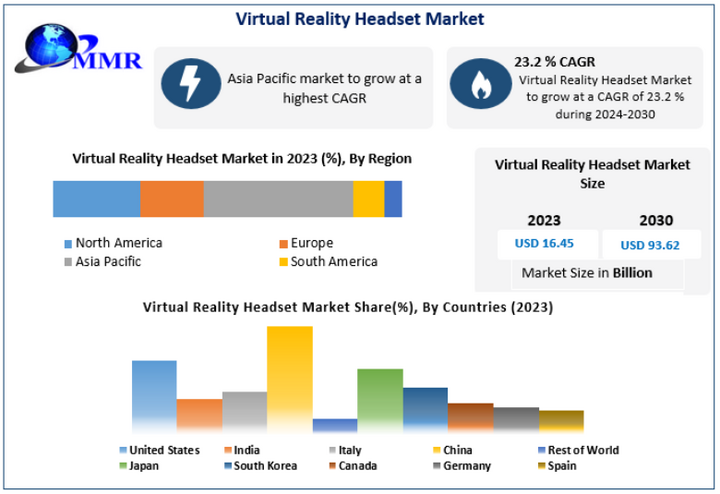
The Global Virtual Reality (VR) Headset Market, valued at USD 16.45 billion in 2023, is set for accelerated expansion. With an impressive CAGR of 23.2%, the market is projected to reach USD 93.62 billion by 2030. As immersive technologies reshape digital interaction, VR headsets are increasingly being adopted across entertainment, enterprise training, industrial design, education, healthcare, and retail.
Market Overview
A virtual reality headset—commonly referred to as a VR headset—creates a fully immersive, computer-generated environment using stereoscopic visuals, surround sound, and advanced motion-tracking sensors like gyroscopes and accelerometers. Modern devices also integrate eye tracking, hand tracking, voice controls, and advanced computing capabilities, making VR more natural and lifelike.
While gaming remains the dominant application, VR’s influence has rapidly expanded into simulation training, medical diagnostics, virtual classrooms, remote collaboration, and experiential retail. The growing emphasis on hyper-realistic visualization and interactive learning is positioning VR as a mainstream technology across both consumer and enterprise segments.
To know the most attractive segments, click here for a free sample of the report:https://www.maximizemarketresearch.com/request-sample/54754/
Market Dynamics
VR adoption is rising across industries such as:
This shift toward digital transformation is creating strong, long-term growth opportunities for VR headset manufacturers.
The combination of VR with artificial intelligence (AI) and machine learning (ML) is enabling:
The fusion of VR and AI is expected to unlock new use cases in collaborative workspaces and immersive content creation.
VR is evolving beyond individual usage into social VR, where users interact with others in shared virtual spaces. This trend is gaining momentum in:
COVID-19 accelerated this shift, increasing demand for virtual events, virtual tourism, and remote training solutions.
Major players are expanding their capabilities through acquisitions.
For example, Facebook’s acquisition of Sanzaru, Inc. strengthened its ability to develop next-generation VR content for Oculus devices.
Segment Analysis
By End Device
High-end Devices
Low-end Devices
Mid-range Devices
By Product Type
By Application
Gaming
Retail
Healthcare, Manufacturing & Education
The diversity of applications underscores VR’s evolution from a gaming accessory to a critical enterprise tool.
To know the most attractive segments, click here for a free sample of the report:https://www.maximizemarketresearch.com/request-sample/54754/
Regional Insights
Asia Pacific – Market Leader (59% Share in 2023)
Asia Pacific will remain the global growth engine due to:
Countries like China, Japan, South Korea, and India are contributing significantly to the region’s dominance.
North America – Strong Growth Outlook
With strong demand in the U.S. and Canada, this region benefits from:
Europe – Expanding Across Industries
Competitive Landscape
The Virtual Reality Headset Market is highly competitive, with companies focusing on content development, hardware differentiation, pricing strategies, and platform ecosystems.
Key Players
From Sony’s deep gaming content ecosystem to Qualcomm’s dominance in VR chipset technology, each player brings unique capabilities to the market.
Conclusion
The Global Virtual Reality Headset Market is on a transformative growth trajectory driven by technological advancements, diversified applications, and rising consumer engagement. Strong adoption across gaming, enterprise training, healthcare, and retail, combined with rapid 5G rollout and AI integration, is paving the way for massive expansion over the next decade.
VR is no longer a niche technology—it is becoming a cornerstone of digital interaction, immersive communication, and experiential innovation. Companies investing early in advanced sensors, optics, software ecosystems, and social VR platforms are likely to lead the next wave of market growth.