
الإشعارات
نشرت من supriya maximize
مصنفة في الأعمال والمشاريع 110 مشاهد
Automotive Market in India: Industry Overview, Growth Drivers, and Competitive Outlook
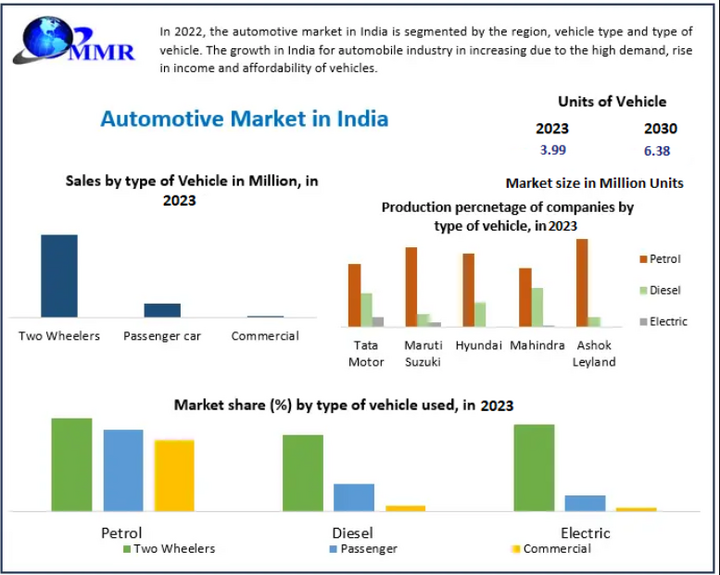
The Automotive Market in India recorded sales of 3.99 million units in 2023 and is projected to reach 6.38 million units by 2030, expanding at a CAGR of 6.94% during the forecast period. India’s automotive industry is one of the fastest-growing in the world, supported by rising disposable incomes, rapid urbanization, policy reforms, and increasing demand for sustainable mobility solutions.
Market Overview
The automotive industry encompasses the design, manufacturing, and sale of vehicles, categorized based on utility, design, and end-use. India has emerged as a global automotive hub due to its strong manufacturing ecosystem, cost-efficient labor, and expanding domestic demand. The market is undergoing a structural transformation driven by electric mobility, fuel efficiency standards, and digital innovation.
The industry analysis leverages both primary and secondary research, offering detailed insights into market dynamics, segmentation, regional trends, and competitive strategies. Strategic tools such as SWOT, PESTLE, and Porter’s Five Forces analysis are used to evaluate the competitive intensity and long-term growth potential of the market.
To know the most attractive segments, click here for a free sample of the report:https://www.maximizemarketresearch.com/request-sample/86126/
Market Dynamics
Rising Vehicle Adoption Driving Market Growth
The expanding young population, increasing middle-class income, and improving road infrastructure are major contributors to the growth of the Indian automotive market. Rapid urban development has significantly boosted demand for personal and commercial vehicles. According to SIAM, total vehicle production across all segments reached 1.69 million units in June 2021, highlighting strong manufacturing momentum.
Government initiatives promoting hybrid and electric vehicles, along with export growth, further strengthen market expansion. Indian automotive exports exceeded 1.4 million units between April and June 2021, reinforcing India’s position as a key global exporter.
High Cost of Advanced Technologies as a Market Restraint
Despite strong growth, the market faces challenges such as rising fuel prices, stringent emission norms, and high technology costs. Adoption of electric vehicles and autonomous driving systems requires substantial capital investment, increasing vehicle prices. Frequent regulatory changes and compliance requirements also create operational challenges for manufacturers.
Additionally, concerns related to air pollution, road safety, and inadequate rural infrastructure pose limitations on market expansion, particularly in underdeveloped regions.
Increasing Investment in Research and Development
India is rapidly evolving into a global automotive R&D hub, supported by initiatives such as Make in India, Atmanirbhar Bharat, and the Automotive Mission Plan (2016–2026). The country accounts for nearly 40% of global engineering and R&D spending, with 8% dedicated to the automotive sector.
The growing focus on connected vehicles, electric drivetrains, and advanced wiring harness systems is accelerating innovation. EV manufacturing has increased demand for components such as sensors, actuators, lithium-ion batteries, and high-voltage wiring systems, driving technological advancement across the value chain.
Environmental Concerns Accelerating EV Adoption
Rising air pollution levels in major cities like Delhi have intensified the shift toward electric and low-emission vehicles. Government incentives, reduced EV taxation, and stricter emission regulations are encouraging consumers and manufacturers to adopt cleaner mobility solutions. Increasing traffic congestion and population growth further underline the need for compact, energy-efficient vehicles.
Market Segmentation Analysis
By Vehicle Type
By Fuel Type
To know the most attractive segments, click here for a free sample of the report:https://www.maximizemarketresearch.com/request-sample/86126/
Regional Insights
Competitive Landscape
The Indian automotive market is highly competitive, with both domestic and global manufacturers actively expanding their presence. Tata Motors leads the market with a strong portfolio across passenger, commercial, and electric vehicles. The company has established a significant export footprint across over 100 countries.
Other major players include Maruti Suzuki, Hyundai Motor India, Mahindra & Mahindra, Hero MotoCorp, Bajaj Auto, Ashok Leyland, and TVS Motor Company. Continuous investments in manufacturing capacity, EV platforms, and advanced technologies define the competitive strategies of these companies.
Conclusion
The Automotive Market in India is set for sustained growth, driven by demographic advantages, policy support, export expansion, and rapid technological innovation. While challenges related to cost, infrastructure, and regulation remain, increasing investments in electric mobility, R&D, and connected vehicle technologies are expected to redefine the industry’s future. India is well-positioned to emerge as a global automotive manufacturing and innovation powerhouse by 2030.