
Notifications
Posted by supriya maximize
Filed in Business 62 view
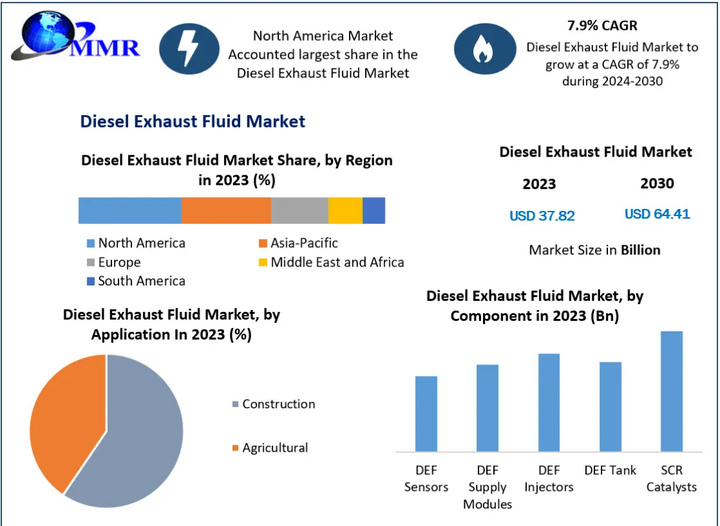
Diesel Exhaust Fluid (DEF) Market Overview
The global Diesel Exhaust Fluid (DEF) Market was valued at USD 37.82 billion in 2023 and is projected to reach approximately USD 64.41 billion by 2030, growing at a CAGR of 7.9% during the forecast period. DEF, also referred to as AdBlue, is a consumable urea-based solution used in Selective Catalytic Reduction (SCR) systems to reduce nitrogen oxide (NOx) emissions from diesel engines. Comprising 32.5% high-purity urea and deionized water, DEF reacts with NOx in the exhaust stream to produce harmless nitrogen and water, supporting compliance with stringent emission standards globally.
The adoption of DEF not only reduces environmental pollutants but also enhances engine efficiency, increases fuel economy, and lowers maintenance costs. The technology has gained traction due to regulatory mandates, such as the US EPA requirements, European Euro 6 standards, and India’s Bharat Stage VI (BSVI) norms, which necessitate the installation of SCR systems in diesel vehicles. DEF is now widely used across passenger vehicles, light commercial vehicles (LCVs), and heavy commercial vehicles (HCVs), as well as non-road machinery in agriculture, construction, and marine applications.
To know the most attractive segments, click here for a free sample of the report:https://www.maximizemarketresearch.com/request-sample/11162/
Market Scope & Research Methodology
The report provides a detailed analysis of the DEF market, including historical data (2018–2023), current market insights, and forecasts for 2024–2030. It examines the drivers, opportunities, challenges, and emerging trends, enabling stakeholders to make informed decisions.
Research Methodology Includes:
The study also includes market segmentation and regional insights to help businesses identify growth opportunities and optimize their strategies.
Market Segmentation
By Vehicle Type:
By Component:
By Application:
Regional Insights
To know the most attractive segments, click here for a free sample of the report:https://www.maximizemarketresearch.com/request-sample/11162/
Key Players
The DEF market is competitive, with leading companies focusing on production expansion, technological advancements, and regulatory compliance. Strategies include mergers and acquisitions, partnerships, and development of efficient SCR-compatible DEF solutions.
Prominent Global Players Include:
These players are expanding production capacities and launching new formulations to enhance performance, extend shelf life, and meet rising DEF demand in both road and non-road diesel applications. For instance, Yara International plans to commission a 200,000-ton annual DEF plant in Austria by 2025 to support growing European demand.
Summary
The Global Diesel Exhaust Fluid Market is poised for strong growth from 2024 to 2030, fueled by stringent emission regulations, adoption of SCR systems, and increasing use across commercial, industrial, and non-road applications. Expanding DEF infrastructure, technological innovations, and government incentives further enhance market opportunities, positioning DEF as a critical component for sustainable diesel engine operation and environmental compliance.