
Notifications
Posted by supriya maximize
Filed in Technology 54 view
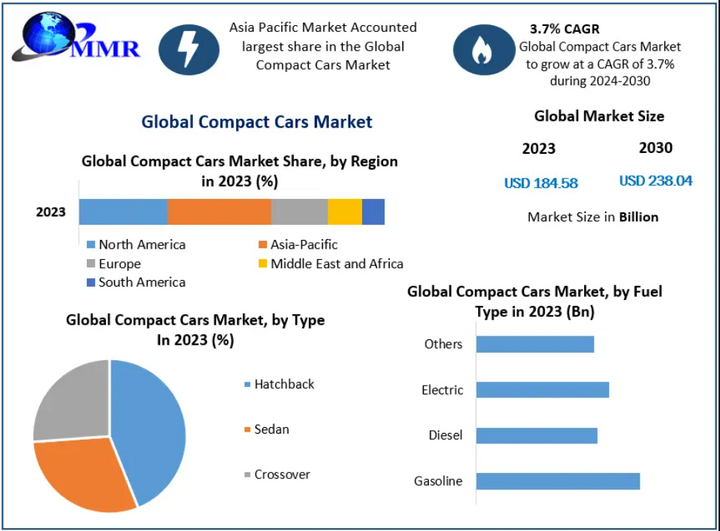
Global Compact Cars Market: Strategic Outlook and Industry Analysis
The global Compact Cars Market continues to play a vital role in shaping modern mobility, particularly in urban and semi-urban environments. Valued at USD 184.58 billion in 2023, the market is projected to expand steadily at a CAGR of 3.7% from 2024 to 2030, reaching an estimated USD 238.04 billion by 2030. The growth trajectory reflects a balanced mix of affordability, fuel efficiency, urban suitability, and evolving consumer expectations.
Market Overview
Compact cars represent a key automotive segment characterized by smaller dimensions, efficient powertrains, affordability, and versatility. These vehicles are designed to offer an optimal balance between performance and practicality, making them highly suitable for congested cities and cost-conscious buyers. Their ease of parking, lower operating costs, and reduced environmental footprint position compact cars as a preferred choice for daily commuting and shared mobility solutions.
As urban populations expand and road congestion intensifies, compact cars have emerged as an effective response to modern transportation challenges. Automakers are continuously enhancing these vehicles with advanced safety systems, infotainment technologies, and connectivity features, making compact cars increasingly attractive to tech-savvy and environmentally conscious consumers.
To know the most attractive segments, click here for a free sample of the report:https://www.maximizemarketresearch.com/request-sample/189727/
Key Market Growth Drivers
Urbanization and Changing Lifestyles
Rapid urban development across emerging and developed economies is significantly driving compact car adoption. With limited parking space and dense traffic conditions, compact cars offer superior maneuverability and convenience, particularly in metropolitan areas.
Fuel Efficiency and Cost Sensitivity
Rising fuel prices and increased awareness of operating costs have made fuel-efficient vehicles more appealing. Compact cars deliver better mileage and lower maintenance costs compared to larger vehicles, aligning well with budget-focused consumers.
Environmental Regulations and Sustainability
Stringent emission norms and fuel-efficiency standards imposed by governments worldwide are encouraging manufacturers to focus on compact and low-emission vehicle platforms. This regulatory push has also accelerated the introduction of hybrid and electric compact cars.
Technological Advancements
Innovations in lightweight materials, engine optimization, electrification, and driver-assistance systems have significantly improved the performance, safety, and appeal of compact cars, supporting sustained market growth.
Market Trends Shaping the Industry
These trends highlight the transformation of compact cars from basic transportation solutions into feature-rich, smart mobility products.
Market Opportunities
The compact cars market presents significant growth opportunities across multiple dimensions:
Manufacturers investing in electrification, connectivity, and safety innovation are well-positioned to capitalize on these opportunities.
Market Challenges
Despite steady growth, the compact cars market faces several challenges:
Addressing these challenges requires strategic product positioning, cost optimization, and targeted regional approaches.
Segment Analysis
By Vehicle Type
The hatchback segment dominated the market in 2023, accounting for over 47% of global revenue, owing to its versatility, compact size, and practical cargo space. Hatchbacks remain especially popular in Asia-Pacific and Europe.
Meanwhile, the sedan segment is witnessing faster growth, supported by advancements in design, comfort, electrification, and safety technologies, particularly in North America and Asia.
By Fuel Type
Gasoline-powered vehicles continue to hold a major share; however, electric compact cars are gaining strong momentum due to regulatory support, declining battery costs, and rising environmental awareness.
By Application
The private use segment dominates the market, while commercial and shared mobility applications are emerging as high-growth areas in urban centers.
To know the most attractive segments, click here for a free sample of the report:https://www.maximizemarketresearch.com/request-sample/189727/
Regional Insights
Asia Pacific
Asia Pacific leads the global compact cars market, driven by rapid urbanization, population growth, affordability, and strong domestic manufacturing. China and India are key growth engines, supported by rising middle-class incomes, fuel-efficiency preferences, and government incentives for electric vehicles. Japan and South Korea contribute through technological innovation and high-quality manufacturing.
Europe
Europe is expected to grow at a moderate pace, with demand fueled by strict emission regulations, environmental awareness, and urban mobility needs. Germany, France, Italy, and the UK are major contributors, with increasing adoption of hybrid and electric compact cars reshaping the competitive landscape.
North America
While SUVs dominate overall vehicle sales, compact cars maintain a steady presence in North America due to fuel efficiency, affordability, and growing interest in electric compact models.
Competitive Landscape
The compact cars market is highly competitive, with global and regional players focusing on new product launches, electrification strategies, partnerships, and geographic expansion. Automakers are leveraging platform sharing, cost optimization, and advanced technologies to strengthen their market position.
Conclusion
The global compact cars market remains a cornerstone of the automotive industry, offering practical, efficient, and increasingly intelligent mobility solutions. As urbanization, sustainability goals, and consumer expectations evolve, compact cars are adapting through electrification, connectivity, and design innovation. While challenges persist, manufacturers that align with emerging mobility trends and regional demands are well-positioned to achieve long-term growth in this dynamic and competitive market.